
Channel catfish are one of the major food fish produced in the southern U.S., including Arkansas, Dr. Yathish Ramena, director of the Center of Excellence, Department of Aquaculture and Fisheries at the University of Arkansas at Pine Bluff, said. These fish are well-suited to water temperatures between 75 to 85 F. However, summer heat waves often push water temperatures beyond this optimal range, surpassing 90 F.
“This rise in temperature causes a significant drop in dissolved oxygen levels in the water,” Dr. Ramena said. “Additionally, increased water temperature leads to higher metabolic rates in the fish, which raises their oxygen demand. The combination of reduced oxygen availability and elevated demand leads to hypoxia, a condition that causes severe stress and can lead to fish kills in ponds.”
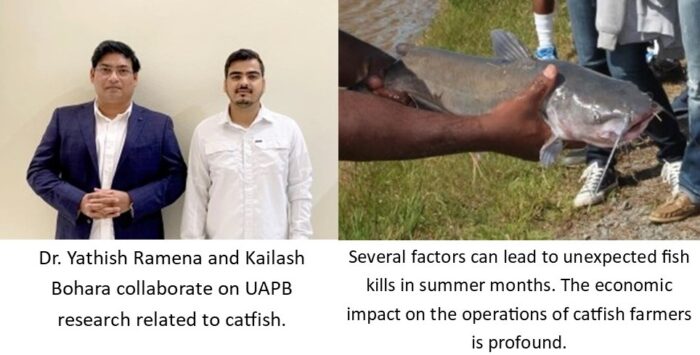
Dissolved oxygen comes from algae, aquatic plants and the natural mixing of atmospheric oxygen into the water. Stagnant water bodies with limited algae and aquatic plant growth are more susceptible to fish kills. However, an overabundance of algae is not beneficial either. The rise in summer temperatures, combined with ample sunlight and high nutrient levels in the water can lead to extensive growth of algae and aquatic plants.Several factors can lead to unexpected fish kills in summer months. The economic impact on the operations of catfish farmers is profound.
Kailash Bohara, Extension specialist of fish health, collaborates with Dr. Ramena on UAPB research related to catfish. He says other factors can contribute to unexpected fish kills.
“While algae and other aquatic plants release oxygen during photosynthesis in the presence of light during the day, they also consume oxygen at night, competing with fish for this vital resource,” Bohara said. “The lack of oxygen during the night can lead to fish kills, particularly in the early morning. Farmers and pond owners are often surprised by sudden fish kills, as daytime measurements of dissolved oxygen typically show normal levels when algae and plants are actively photosynthesizing and not competing with fish for oxygen.”
Algal blooms lead to drastic swings in oxygen levels. Oxygen peaks during the late afternoon and plummets at night, reaching critically low levels just before dawn. These fluctuations are stressful for the fish and can result in mass fish kills.
Bohara said the economic impact on the operations of catfish farmers due to these environmental stresses is profound. The increased fish mortality rates, slower growth and higher incidence of disease translate into smaller harvests and reduced profits. Farmers also incur additional costs for aeration systems to maintain adequate oxygen levels in their ponds.
Dr. Ramena said that despite additional costs, aeration is key to addressing the problem of dissolved oxygen depletion during the summer. Producers aerate their ponds using different types of aerators including sidewinder paddlewheel aerators, electric paddlewheel aerators and vertical pump aerators.
Generally, paddlewheel aerators are used by commercial farmers while small pond owners can use vertical pumps and fountains to aerate their ponds, he said. Catfish ponds generally require 1-3 hp/acre of paddlewheel aerators during summer. Catfish farmers need to consider aeration, especially from mid-May to mid-September. However, it is highly recommended to use aeration based on the water temperature whenever necessary.
“While producers might find the cost of running aerators problematic, running them during the night will help prevent future fish kills due to oxygen depletion,” he said.
Dr. Grace Ramena, director of UAPB’s Fish Health Diagnostic Lab and Fish Health Inspection Lab at Lonoke, said UAPB’s fish health inspection and disease diagnostic labs at Lonoke and Pine Bluff are currently conducting various research projects based on the current needs of catfish farmers in Arkansas. Some of them include mitigating the high carbon dioxide concentration in Arkansas well water using various mechanical approaches; alternative feed ingredient inclusion in channel catfish diets to enhance the survival and health of channel catfish fingerlings; and Syzygium-CS/TPP nanoparticles as prophylactics to treat A. hydrophila in catfish.
For assistance with fish health, inspections, and water quality issues, contact Dr. Grace Ramena at (870) 575-8137 or [email protected] or Kailash Bohara at (501) 676-3124 or [email protected].
The University of Arkansas at Pine Bluff offers all its Extension and Research programs and services without regard to race, color, sex, gender identity, sexual orientation, national origin, religion, age, disability, marital or veteran status, genetic information, or any other legally protected status, and is an Affirmative Action/Equal Opportunity Employer.


