By David Hehemann
As the U.S. Department of Education prepares to mark National Historically Black Colleges and Universities (HBCU) Week in September, individuals across the nation can look to Arkansas as an example of a state producing highly-qualified graduates dedicated to solving complex challenges, according to Miranda Perez, program coordinator for the HBCU Founders Initiative (HBCUFI).
Perez said HBCUFI supports students, alumni and faculty at HBCUs who want to develop tech-enabled solutions that address systemic issues. The organization was launched by Nex Cubed, a global venture accelerator that invests in and supports promising entrepreneurs.
“At HBCUFI, our core thesis is that by providing under-resourced innovators and entrepreneurs at HBCUs with access to capital and curriculum to scale their startups, we can help reduce the racial wealth gap that has persisted for generations,” she said.
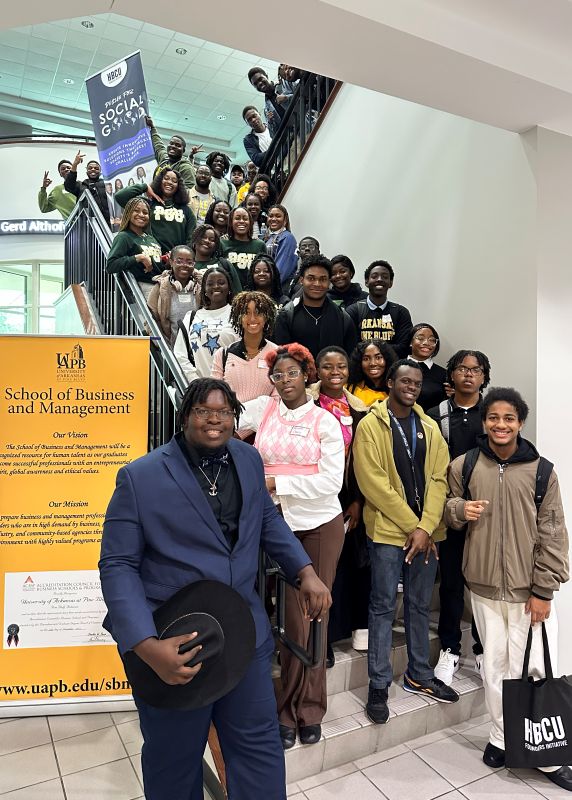
With support from the Walton Family Foundation and Microsoft, the organization has expanded its presence in the Delta, including in Arkansas with the addition of the University of Arkansas at Pine Bluff (UAPB) and Philander Smith University.
“Too often, entrepreneurial resources are concentrated on the East and West Coasts, far from most HBCUs,” Perez said. “We hope the expansion in Arkansas serves as a powerful affirmation to young innovators that founders in any geographic region have the potential to build impactful solutions.”
Perez points to two members of the UAPB community who demonstrate the innovative, tech-driven talent being produced at Arkansas’ HBCUs. Garland Trice, a 2010 graduate of computer science, and Mateo Cook, a sophomore majoring in industrial technology management and applied engineering, are not only innovating in their own fields, but they are also showing the impact that can be made when students and graduates from different HBCUs collaborate.
“Mateo and Garland exemplify the spirit and mission of the HBCU Founders Initiative through their commitment to driving both local and national impact,” she said. “They are passionate about leveraging technology as a force for good and understand that the path to lasting change and wealth creation lies in scalable innovation.”
HBCU Founders Initiative Enables Garland Trice to Achieve Lifelong Business Dreams
Though his career has taken him to Oakland, California, Garland Trice traces his passion for entrepreneurship to his hometown of Pine Bluff. As a child, he found a role model in his father, who always had an idea for a business.
“When friends asked what my father did for a living, I had trouble answering – his job was always different depending on the season,” Trice said. “In wintertime, he had a tree-cutting business, and at other times, he ran a taxi company. His inventiveness and resilience really motivated me.”
The strong sense of community in Pine Bluff also shaped his outlook.
“Whether at the local fish market or clothing store, you were being serviced by people you knew personally,” he said. “Growing up in Pine Bluff gave me a grounded perspective and a deep appreciation for making the most with limited resources.”
Guided by his dream to start his own company, Trice hit the ground running after enrolling at UAPB. As a freshman, he secured a computer science research internship at Iowa State University, which allowed him to learn new programming languages.
The following year, representatives of Microsoft came to UAPB to interview juniors and seniors for internships. Though Trice was only a sophomore, he was the only one to be offered a job because of his diversified resume.
After graduating in 2010, he joined Microsoft’s headquarters in Redmond, Washington as a software development engineer.
“The pay at Microsoft was good, but after four years I had the entrepreneurial itch and wanted to help create something from the ground up,” he said.
Trice took a risk by leaving for a startup, trading a higher salary for creative freedom. After six years there, he was ready to build something of his own.
In 2023, he founded Bruce, an AI-driven startup that helps entrepreneurs efficiently manage their social media presence. Seeking funding, he applied twice to join a Nex Cubed accelerator cohort but was rejected both times. Still, administrators urged him to join HBCUFI to gain new perspective – and then to try again.
“I had initial hesitations about joining HBCUFI because of the time commitment – at the time, I was eager to gain capital,” Trice said. “In the end, joining the program was a complete game changer.”
Through HBCUFI’s pre-accelerator program, he gained candid feedback from investors and honed his skills in building business models. Later, he competed in a pitch event judged by Nex Cubed leaders.
“This was a chance to apply to them in person and explain my vision,” he said. “My failed applications helped my case – they showed I wasn’t quitting.”
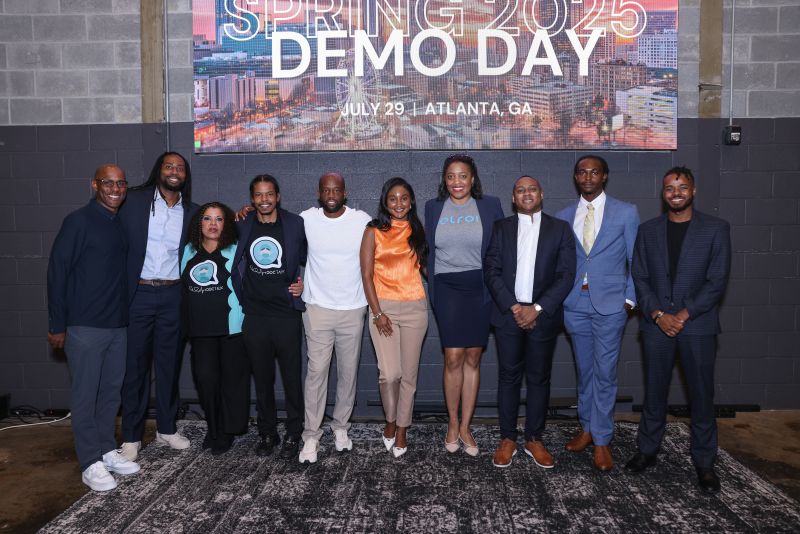
Trice won the competition, earning $5,000 and a spot in Nex Cubed’s spring 2025 cohort. Since then, Bruce has raised $120,000 in pre-seed funding, and Trice was one of five HBCUFI alums selected for Nex Cubed’s HBCU Founders Fund.
“As someone who grew up in a small town full of hardworking entrepreneurs, I want Bruce to be the tool that helps the next generation thrive and stand out in a digital world that’s too often stacked against them,” he said.
Perez said that while Trice’s journey shows how HBCUFI empowers graduates to bring ideas to market, current students like Mateo Cook are also discovering how the initiative can shape their paths.
Mateo Cook Finds Abundance of Opportunity, Community in Pine Bluff
Originally from San Diego, Cook always knew he wanted to attend an HBCU but was unsure where to pursue his degree. After touring various HBCUs and then attending a summer STEM Academy at UAPB, he was certain he needed to move across the country to Pine Bluff.
After enrolling at UAPB, he was immediately struck by the amount of opportunity both on campus and in the community.
“Coming from Southern California, Arkansas has completely reshaped my perspective,” he said. “Here, innovation is about community impact. It’s about elevating each other and finding practical solutions with the tools and resources you have.”
Eager to gain experience, Cook joined UAPB’s chapter of the National Society of Black Engineers and began attending networking events. When he went to his first HBCUFI meeting, he knew he was exactly where he needed to be.
He was selected to attend HBCUFI’s Designing for Social Good Workshop, during which he developed an app to help UAPB faculty, staff and students learn how best to take advantage of the campus’ technology. Later, he met with representatives of the Walton Family Foundation and Microsoft and emphasized the need for expanded HBCUFI programming at UAPB.
“The HBCU Founders Initiative is crucial because it provides the two things innovators need most – resources and validation,” he said. “Many of us have brilliant ideas, but the path from a concept in a lab to a viable product is complex. The initiative offers mentorship, communication skills and a network that helps demystify this process.”
Cook believes HBCUFI’s support is essential for addressing society’s most significant challenges, which require diverse perspectives.
“HBCUs are powerhouse generators of diverse talent,” he said. “By supporting HBCU founders, the initiative ensures the next generation of world-changing companies is built by leaders who represent the full spectrum of our society.”
Through the program, he has valued seeing what happens when students and alumni from different HBCUs work together.
“Imagine a team that includes a student expert on AI from Howard University, a Morehouse College student in business development, and a UAPB student such as myself in applied engineering and management,” he said. “Together, we can build something far more impactful than any of us could alone.”
As public relations chair for UAPB’s National Society of Black Engineers, Cook wants to foster these types of connections, both on campus and beyond.
“The experiences I’ve had at UAPB and through HBCUFI have taught me that true impact is about the value of the work you do and the collaborative spirit you bring,” he said.