
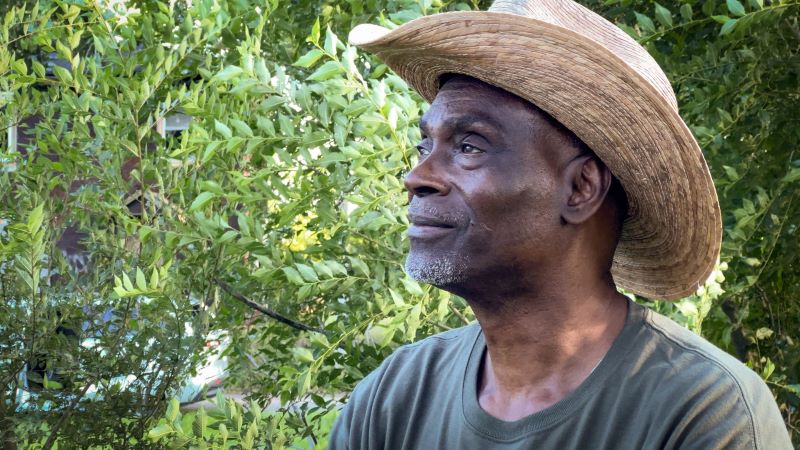
Pine Bluff, AR — For James Bunch, agriculture has always played an important role in his life. Born on July 4, 1957, in the rural, east Arkansas town of Cotton Plant, Bunch grew up in a family of 16 children. His early memories include helping out on the family farm, where they grew traditional vegetable and row crops.
“We shared 60 acres of family land with an uncle who lived across the road,” Bunch said. “We grew crops such as cotton, soybeans and corn, and we also raised hogs and chickens. Being from a low-income community, we relied on these products for our livelihood. And at home, we ate the vegetables we grew. I like to say we were vegan before being vegan was cool.”
In high school, Bunch showed a talent for track and field, particularly in the 440-yard dash and mile relay. Eventually, he was offered a full athletic scholarship to attend the University of Arkansas at Pine Bluff (UAPB).
“My family was ecstatic about my scholarship,” Bunch said. “My brother Theodis had started attending UAPB in 1971, and we saw how his degree took him from the cotton field to the air-conditioned office.”
Just as attending UAPB seemed like a natural choice for Bunch, so was the major he chose – agriculture with a focus in agronomy and soil science.
“I wanted to combine my practical experience with scientific knowledge,” he said. “I knew the basics of farming – I had been growing crops since I was a child. At this point, I wanted the scientific background to understand the relationship between the plants and soil and learn the ins and outs of nutrients and irrigation.”
Throughout his studies, Bunch continued to make progress in track and field. During the spring of 1979, he broke the Arkansas state record in the 440-yard dash with a time of 45.6, a record that would stand for 11 years.
Bunch credits Levanders Randall, track coach at Cotton Plant Vocational High School, and Ulysses S. Grant, long-time track and field coach at UAPB/AM&N, with providing him the wherewithal to balance his academic and athletic goals.
“My coaches taught me the importance of being competitive both on and off the field,” he said. “They showed me that I had the heart and the drive to achieve. Thanks to them, I learned how to take the determination I showed in track and apply it overall in my life and career. Athletics taught me many lessons, including the importance of working with others to achieve a common goal.”
As he was pursuing his degree, during the summer months, Bunch began a series of internships that would shape his career trajectory. It all began when he started working for the U.S. Department of Fish and Wildlife in Minnesota in 1976. Eventually, he got his foot in the door at the Soil Conservation Service, now known as the Natural Resources Conservation Service (NRCS).
He would go on to have a 35-year career with the agency, serving in a number of roles. In 1979, he was hired as a soil conservationist in McGehee, Arkansas, and in 1988 he was promoted to district conservationist in Marion, Arkansas. After earning a master’s degree in agronomy from Alcorn State
University in Lorman, Mississippi in 1990, he began working as Alcorn’s advisor for the NRCS Crop Factor Project, as well as the Revised Universal Soil Loss Equation Project.
In 1994, Bunch was hired by the National Plant Data Center in Baton Rouge, Louisiana. In 1999, he moved back to Arkansas and began working as a regional technology specialist, the position he worked in until his retirement in 2012.
“After I retired, eventually I got tired of sitting around, so I opened up my own consultant business in 2015,” he said. “The NRCS offers contracts for organizations offering outreach work with underserved communities. In 2018, I got my first contact with the NRCS and began working on projects with goals such as informing minority producers about NRCS services, recruiting beginning farmers and popularizing the use of high tunnel systems.”
The TV series – Green Acres meets hip-hop
As Bunch continued growing his consultant business, he began to reflect on the need to popularize the field of agriculture among young Americans, especially among Black, Hispanic and other minority youth. But the question remained – how best to reach young people?
“I started thinking about how we need to be more innovative in reaching young people,” he said. “Our youth are spending free time on their phones on popular apps such as TikTok and Instagram. What if content creation for platforms like these is key for the future of agricultural outreach?”
Bunch started devising an idea for a video series called “Hip Hop Farmers” that would encourage minority youth to consider agricultural careers and highlight the broad services of the USDA.
“Think Green Acres meets hip-hop,” Bunch said. “In my series, a young New York City hip-hop music mogul relocates to Memphis, Tennessee after the unexpected passing of a dear college friend. Along with his fashion influencer fiancée, he takes on the challenge of running an urban farm in a community struggling to survive gentrification.”
In the video series, the three main characters met and bonded while attending UAPB. Two earned degrees in agriculture, while the third pursued a degree in music. Bunch believes this unique mix of themes will appeal to the millennial generation.
“The series not only works to recruit youth to agriculture by presenting a compelling story, but it also demonstrates how families can use USDA resources to make their family farms profitable and sustainable,” he said.
In celebration of Black History Month, Bunch plans to screen the pilot episode at the UAPB campus. More details on the event will be released in subsequent press releases. To view the “Hip Hop Farmers” trailer, visit https://www.PickinGreensProductions.com. For more information about the video series, contact Bunch at [email protected].
The University of Arkansas at Pine Bluff offers all its Extension and Research programs and services without regard to race, color, sex, gender identity, sexual orientation, national origin, religion, age, disability, marital or veteran status, genetic information, or any other legally protected status, and is an Affirmative Action/Equal Opportunity Employer.


