
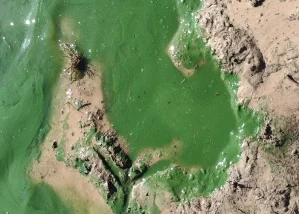
Blue-green algae, also known as cyanobacteria, occurs every summer in Arkansas, Scott Jones, small impoundment Extension specialist at the University of Arkansas at Pine Bluff, said. The hottest part of the season tends to be the period where potentially harmful blue-green algae blooms are most prevalent. This is caused partially from the temperature, but most importantly from nutrient accumulation.
During the summer, flushing rainfall events are less common and water loss from evaporation concentrates nutrients. The worst blooms occur in ponds with heavy organic accumulation (muck), excessive fertilization or feeding of fish, or where the land draining into the pond is over fertilized or produces excessive organic waste (especially around heavy poultry production as the litter is high in phosphorous), and ponds where livestock have uncontrolled access to the water, Jones said.
“When the blooms are of sufficient density to cause health issues, they tend to take the form of floating surface scums that resemble spilled paint in hues of bright green, blue, red, grey and several shades between,” he said. “One quick way to identify blue-green algae is dipping a stick into the surface scum. If the stick comes back out coated in the scum, like paint, it’s likely a blue-green algae scum.”
Also, placing a water sample with some of the scum in a jar left in a refrigerator overnight can provide evidence. If the next morning there is a ring of the scum still floating at the surface of the water in the jar, it is likely a blue-green algae scum, Jones said. Other floating plants, like watermeal, azolla, duckweed, and even some floating segments of submersed weeds, can sometimes be mis-identified as algal scums.
“Blue-green algae are photosynthetic bacteria that can out-compete beneficial green algae. Of the few thousand species of blue-green algae, several are capable of producing neuro- or hepatotoxins that can cause sickness to mortality in animals hours to days after ingestion,” he said. “Fish are also vulnerable to these toxins and significant mortalities can occur during excessive blue-green algae blooms.”
Potentially toxic blue-green algae species are not always producing toxin. The only way to confirm the presence of toxin is laboratory testing, he said.
In addition to several private labs, the Arkansas Water Resources Center Water Quality Lab can identify algae and test for the presence of algal toxins, Jones said. Contact the lab at (479) 502-9843. For a list of additional capable labs, contact the Arkansas Department of Environmental Quality at (501) 682-0744. The analysis can take several days so avoid exposure and keep animals from the affected water until results are returned.
Blue-green algae blooms can be treated with aquatic herbicides containing copper sulfate or sodium carbonate peroxyhydrate. Animals should be excluded from the pond for at least one week after herbicide treatment because toxin concentration will likely temporarily increase as the blue-green algae is dying from herbicide, Jones explained.
“Herbicides will only provide two to three weeks of relief before the bloom returns in most situations. For long-term control, a nutrient binder is needed to strip phosphorous from the water to slow the return of the bloom,” he said. “Apply a commercially available flocculant (EutroSORB G, Phoslock or Phosclear are brand name examples) about one week after herbicide application. It may take a few cycles of this treatment (herbicide/flocculant) during the year to slowly bring nutrients and algae blooms back under control.”
Aquatic dye, particularly those containing Acid Yellow 23 and that are EPA-registered, can help somewhat with suppressing algae blooms, Jones said. There are no practical biological controls. The best solution is prevention by minimizing nutrient input from fertilizer runoff, poultry litter, livestock loafing/wading in the pond and over feeding fish.
“Old, excessively shallow livestock ponds (less than 3 ft average depth) may be better off with a full renovation; draining and excavating accumulated sediment, restoring shoreline slopes, and deepening the pond back to at least 4 ft average depth with up to 10-12 ft max depth,” he said. “If renovation is deemed the best route, strongly consider installing external watering systems and fencing the pond off from animal contact.”
For more information about blue-green algae in ponds, contact Jones at (870) 575-8185 or [email protected], or contact your local county Extension office.
The University of Arkansas at Pine Bluff offers all its Extension and Research programs and services without regard to race, color, sex, gender identity, sexual orientation, national origin, religion, age, disability, marital or veteran status, genetic information, or any other legally protected status, and is an Affirmative Action/Equal Opportunity Employer.


