
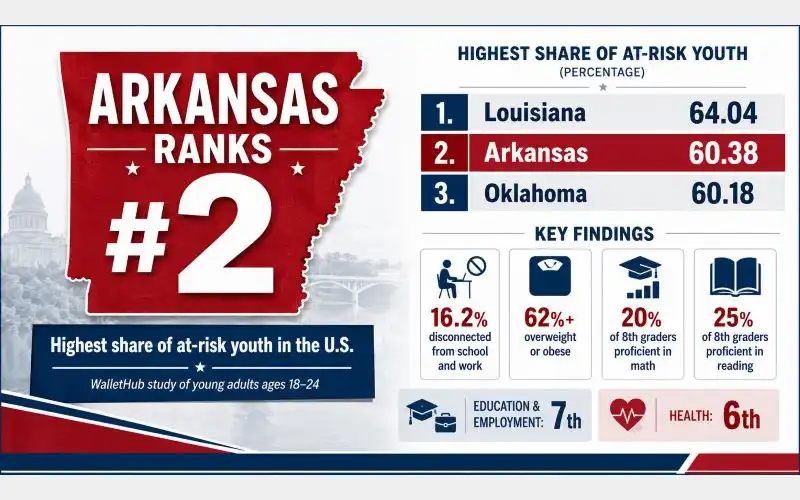
Arkansas ranks second in the nation for the highest share of at-risk youth, according to a recent study from consumer finance website WalletHub.
The study evaluated states based on challenges facing young adults ages 18 to 24 during the transition into adulthood.
Researchers examined 15 indicators across two categories: education and employment, and health.
Arkansas received an overall score of 60.38, ranking behind only Louisiana, which scored 64.04. Oklahoma ranked third with a score of 60.18.
The education and employment category examined factors including the percentage of young adults who are not attending school or working, youth poverty rates, teen pregnancy rates and youth detention rates.
The health category considered factors such as obesity rates, substance use and the share of youth experiencing physical, mental or emotional limitations.
Arkansas ranked seventh nationally in the education and employment category and sixth in the health category.
According to WalletHub’s analysis, one of Arkansas’ largest challenges is the percentage of young adults who are disconnected from both school and the workforce.
The study found 16.2% of Arkansas residents ages 18 to 24 are not enrolled in school, not participating in the workforce and have not pursued education beyond high school.
Researchers said that population faces increased barriers to employment opportunities and long-term earning potential.
Educational performance was also identified as a contributing factor.
Data from the National Assessment of Educational Progress shows 20% of Arkansas eighth graders perform at or above proficiency in math, while 25% meet that benchmark in reading.
Health outcomes also contributed to Arkansas’ ranking.
The study found more than 62% of young adults in the state are classified as overweight or obese, the highest rate among states included in the study.
WalletHub’s ranking compared all 50 states and Washington, D.C., using factors related to education, employment, financial stability and health to identify areas where young adults may face greater challenges transitioning into adulthood.