
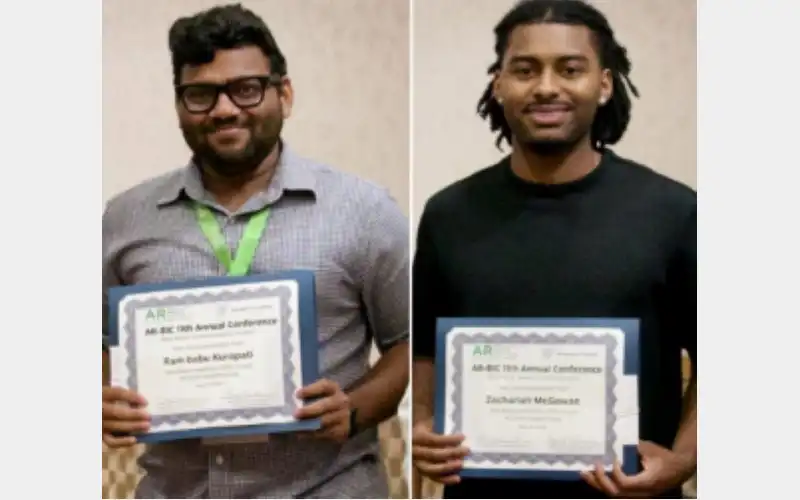
Graduate students from the University of Arkansas at Pine Bluff (UAPB) earned top honors at the Arkansas Bioinformatics Consortium (AR-BIC) 11th Annual Conference, capturing first- and third-place awards in the graduate student poster competition held recently in Little Rock.
Representing UAPB’s Department of Aquaculture and Fisheries, master’s degree student Ram babu Kurapati earned first place for his innovative artificial intelligence (AI)-powered aquaculture platform, while graduate student Zachariah McGowan received third place for his research focused on improving fish disease management.
“Their achievements highlight UAPB’s commitment to developing practical, research-based solutions that address challenges facing Arkansas aquaculture producers,” Dr. Yathish Ramena, director of UAPB’s Department of Aquaculture and Fisheries, said.
UAPB students are proving that innovative research and real-world impact go hand in hand, Dr. Christopher C. Mathis Jr., interim dean/director for UAPB’s School of Agriculture, Fisheries and Human Sciences, said.
“Having two graduate students earn top honors at a statewide conference is an outstanding achievement, and it’s a credit to their hard work and the mentorship they receive from our faculty,” he said. “This recognition reflects the culture of scholarship and discovery we continue to build at UAPB.”
First-Place Research Advances Precision Aquaculture
Working under the mentorship of Dr. Yathish Ramena, Kurapati developed an AI-driven aquaculture platform capable of identifying, counting and measuring fish from a single photograph. The technology estimates fish length, weight, population size and growth performance without requiring fish to be manually handled, reducing labor demands and minimizing stress on fish.
The platform was trained using more than 9,000 annotated fish images and achieved more than 95% accuracy during independent testing. Designed with accessibility in mind, the system operates through a web-based interface that can be used on smartphones, tablets and computers, making it practical for aquaculture operations of all sizes.
In addition to fish measurement capabilities, the platform incorporates real-time feeding management. Sensors monitor feed consumption in ponds and automatically adjust feeding rates based on fish activity, helping producers reduce feed waste, improve growth performance and increase operational efficiency.
Researchers are currently expanding the platform to support largemouth bass and channel catfish, two of Arkansas’ most economically important aquaculture species, Dr. Ramena said. Future enhancements will include water-quality monitoring and commercial-scale deployment.
“Ram babu’s work demonstrates how emerging technologies such as artificial intelligence can provide practical solutions for aquaculture producers,” he said. “By combining machine learning, image analysis and automated feeding systems, this project has the potential to improve efficiency, reduce production costs and support sustainable fish-farming practices. We are proud to see this research recognized at the state level.”
Third-Place Research Targets Fish Health Challenges
McGowan’s research focused on combating Streptococcus iniae, a bacterial pathogen responsible for significant losses in aquaculture operations worldwide. The disease affects more than 30 fish species and can cause severe symptoms, including internal hemorrhaging, eye damage and high mortality rates. Because the pathogen can also infect humans, disease control remains a critical priority for the aquaculture industry.
Under the guidance of Dr. Grace Ramena, associate professor – fish pathology
director, fish health inspections/disease diagnostics, McGowan’s research explores alternatives to conventional antibiotic treatments in response to growing concerns about antimicrobial resistance.
The research team engineered nine specialized fusion constructs that combine bacteria-killing enzymes with cell-penetrating molecules, Dr. Grace Ramena said. These constructs are designed to enter infected fish cells and eliminate bacteria hidden within them, overcoming one of the major limitations of traditional treatments.
Laboratory testing using infected tilapia brain cells demonstrated that several of the engineered constructs significantly reduced bacterial populations and outperformed standard enzyme treatments, she said. The next phase of the project will evaluate the technology in live fish models, bringing the research one step closer to commercial application.
“Zachariah’s research addresses one of the most pressing challenges facing aquaculture today–disease control in an era of increasing antibiotic resistance,” said Dr. Grace Ramena. “His work explores innovative approaches to targeting bacterial infections at the cellular level and has the potential to contribute significantly to the development of safer and more sustainable disease-management strategies for the aquaculture industry.”
The success of both students underscores UAPB’s growing leadership in aquaculture innovation and applied research, Dr. Yathish Ramena said. While Kurapati’s AI platform offers producers new tools for improving production efficiency and reducing operational costs, McGowan’s research advances disease-control strategies that may reduce reliance on antibiotics and improve fish health outcomes.
Arkansas is home to one of the nation’s largest freshwater aquaculture industries, with channel catfish, largemouth bass and baitfish production contributing significantly to the state’s agricultural economy, he said. Both projects directly address industry challenges and demonstrate the value of research-driven solutions.
“Having two students place among the top three presenters at a statewide conference is a tremendous accomplishment,” said Drs. Yathish and Grace Ramena. “These awards highlight the talent of our students, the quality of their research and the collaborative environment that supports innovation and scientific discovery at UAPB.”
Dr. Yathish Ramena acknowledged the university’s leadership for supporting student research and innovation.
“I am deeply grateful to Dean Dr. Christopher Mathis, Provost Dr. Bruce McGowan and Chancellor Dr. Anthony Graham for their unwavering support of research and graduate education at UAPB,” he said. “Their commitment to academic excellence enables our students to pursue innovative research, present their work at professional conferences and achieve recognition that brings positive visibility to the university. Their encouragement and timely support continue to play a critical role in the success of our students and faculty.”